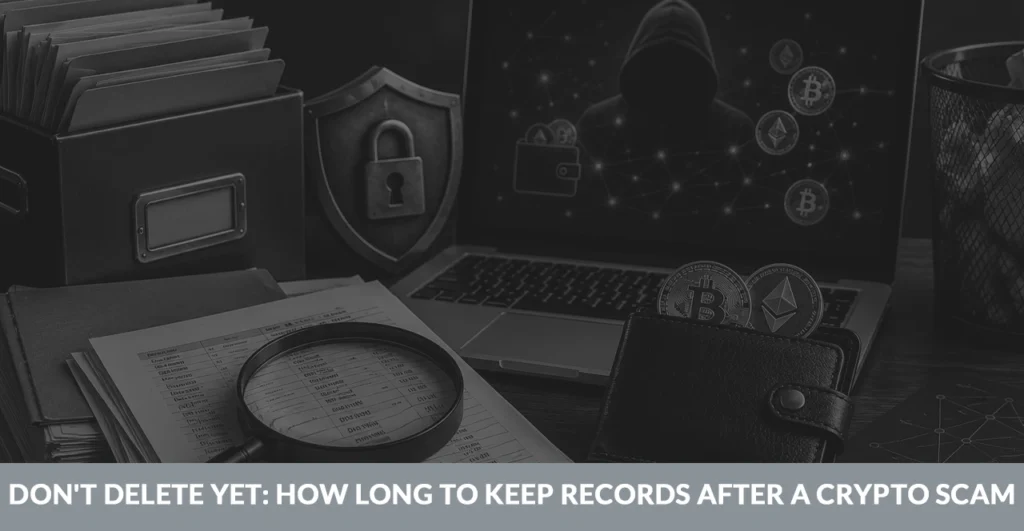
Getting scammed makes you want to erase every trace of it. The messages, the wallet address, the app you downloaded at 2 am. Don’t. Here’s why those records matter more after the fact than they did before.
The Instinct to Delete Is Normal – and Wrong
Once you realize you’ve been scammed, the first reaction is rarely “let me organize my evidence.” It’s shame. It’s anger. It’s the urge to close the app, block the number, and pretend the last few weeks didn’t happen.
That instinct makes sense. Nobody wants a screenshot of their worst financial decision sitting in their camera roll.
The issue is that the only thing preventing you from having an unsuccessful lawsuit is those screenshots, wallet addresses, and conversation logs. You’re not only getting rid of a terrible memory when you delete them. You’re erasing the evidence that could get some of your money back.
What Actually Counts as a Transaction Record
People usually think “transaction record” means the crypto transfer itself. That’s only part of it. Investigators, exchanges, and even your bank will want a fuller picture, including:
- Wallet addresses (yours and theirs)
- Transaction hashes (TXIDs) for every transfer
- Screenshots of the platform or app you used, especially balances and withdrawal attempts
- All chat logs – Telegram, WhatsApp, email, whatever the scammer used
- Any names, phone numbers, or usernames tied to the scam
- Bank statements showing the fiat-to-crypto conversion, if that’s how it started
If it touched the transaction in any way, it’s worth keeping. You won’t know which piece matters until someone asks for it.
So How Long Should You Actually Keep This Stuff?
Here’s the honest answer: longer than feels necessary.
Most people assume that once a case is closed, or once they’ve accepted the money is gone, the records can go. But recovery efforts, law enforcement investigations, and even tax situations don’t move on your timeline.
A case that looks dead in month two can resurface in month eight when an exchange finally responds to a subpoena. A reasonable minimum is three to seven years.
That’s not an arbitrary number – it lines up with how long many financial institutions retain their own records, and it covers the window where tax authorities can still ask questions about crypto losses or gains.
Keep everything until you are specifically informed that the case is closed if law enforcement is actively involved. And even then, keep it for a bit longer.
Indeed, it’s a long time to cling to something unpleasant. However, the alternative is worse: discovering you erased the record the week after the scam occurred and then needing it eighteen months later.
There’s also a practical side to this that people forget. If you claim the loss on your taxes, or if you’re ever audited, you’ll need proof that the loss actually happened – not just a vague memory of “I sent money to a fake platform once.”
Tax authorities in most places accept crypto losses as deductible under certain conditions, but only with supporting documentation. No records, no deduction.
Where This Actually Goes Wrong
The most common mistake isn’t forgetting to save anything. It’s saving it in one place, and one place only.
A phone gets a new owner. An app gets uninstalled during a “fresh start.” A cloud account gets forgotten. Suddenly the one file that mattered is gone, and there’s no way to prove what happened.
Back everything up in at least two separate places – a cloud folder and a physical drive, for example. Instead of depending on the app to still function in a year, export chat records as PDFs. You don’t know in advance which screen will matter, so take screenshots of everything, even the dull sections.
Why This Is More Important Than It Appears
Recovery cases are slow. Recovery Investigators are working with limited resources, exchanges answer requests on their own schedule, and cross-border crypto tracing can take months before anything moves. Every piece of documentation you kept is one less thing standing between “possible recovery” and “no way to prove it happened.”
Staying mired in the time you were conned is not the point of this. It’s about protecting your ability to act when the time comes.
The Bottom Line
Deleting the evidence feels like closing the chapter. In reality, it’s closing the door on ever getting anything back.
Keep the records. Back them up twice. And permit yourself to revisit them only when you actually need to – not because you’re dwelling on it, but because moving forward doesn’t mean moving on without proof.